24/12/10

Yamaha FZ8 2011 cập cảng Việt Nam

Phiên bản 2011 của mẫu môtô phân khối lớn thay thế dòng Yamaha FZ6 đã có mặt tại Sài Gòn chiều 21/12.

Mục tiêu của Yamaha là biến FZ8 2011 thích nghi với cảnh đông đúc nội đô nhưng vẫn mạnh mẽ trên đường trường. Động cơ 780 phân khối tạo ra sự khác biệt với những chiếc 600. Tuy nhiên, Yamaha vẫn hướng tới các yếu tố thời trang, tính năng vận hành và dễ điều khiển.

Yamaha FZ8 2011
Cặp đôi Yamaha FZ8 2011 xuất hiện tại Sài Gòn.

Trái tim FZ8 2011 là khối động cơ 779 phân khối, được làm mới xi-lanh, piston, để đảm bảo vận hành trong những con đường đô thị, ở vòng tua máy thấp. Nhưng vẫn đáp ứng đủ sức mạnh Yamaha trên xa lộ khi vòng tua lên cao. Động cơ đạt công suất 102 mã lực tại vòng tua máy 10.000 vòng/phút, mô-men xoắn cực đại 82 Nm tại vòng tua máy 8.000 vòng/phút.

Khung sườn FZ8 chia sẻ với mẫu xe 1.000 phân khối Yamaha FZ1. Chiều cao yên tính từ mặt đất là 815 mm. Vị trí ngồi của FZ8 thiết kế lại so với FZ6 để thuận tiện cho người lái hơn.

Theo đại diện Saigonmoto, đơn vị nhập khẩu Yamaha FZ8 2011, mẫu xe mới của Yamaha có mức giá tham khảo tại thị trường nước ngoài ở dưới 7.000 USD.

Yamaha FZ8 2011
Yamaha FZ8 2011
Yamaha FZ8 2011 được chia sẻ thiết kế từ hai mẫu xe FZ1 và FZ6.
Yamaha FZ8 2011
Phần đầu Yamaha FZ8 2011 nổi bật với cụm đèn pha kích thước lớn.
Yamaha FZ8 2011
Yamaha FZ8 2011 sử dụng vỏ (lốp) sau kích thước 180mm.
Yamaha FZ8 2011
Phần đuôi Yamaha FZ8 2011 cũng giống như những chiếc FZ1.
Yamaha FZ8 2011
Yên xe có chiều cao 815mm.
Yamaha FZ8 2011
Động cơ với 4 xi lanh thẳng hàng làm mát bằng dung dịch có dung tích 779 phân khối.
Yamaha FZ8 2011
Thắng đĩa kép đường kính 310mm.
Yamaha FZ8 2011
Yamaha FZ8 2011 có bình xăng dung tích 17 lít.
Yamaha FZ8 2011
Cụm đồng hồ trên Yamaha FZ8 2011.
Yamaha FZ8 2011
Giảm sóc đơn (monoshock) dành cho bánh xe sau của FZ8 2011.
Yamaha FZ8 2011
Yamaha FZ8 sử dụng hộp số 6 cấp.

Theo vnexpress

Super Iron

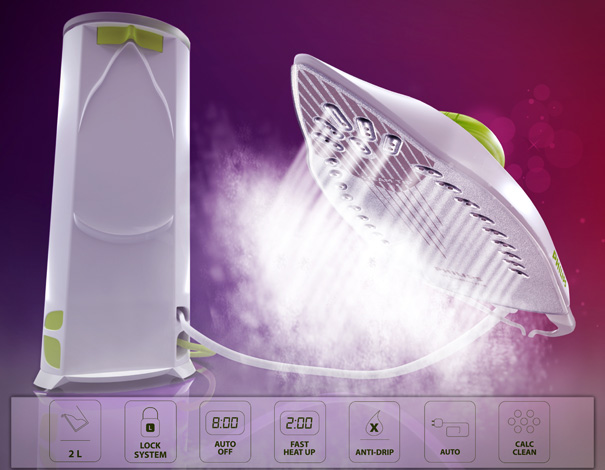
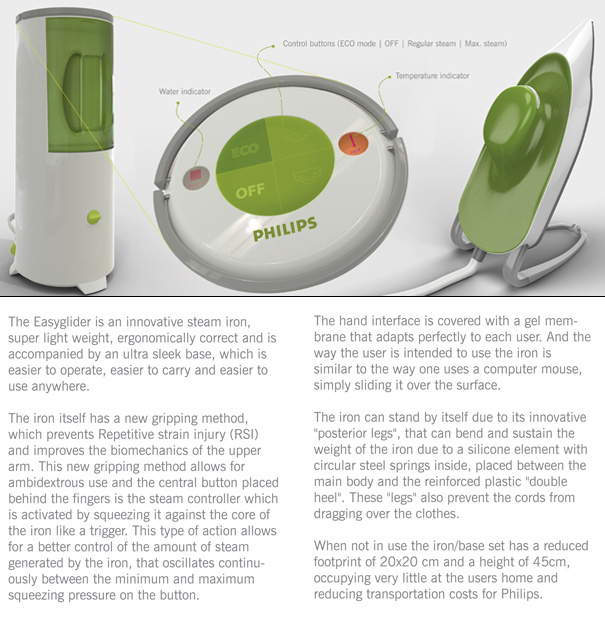
The Easyglider is an innovative steam iron concept developed for Philips by Studio NAMIC. It is super light weight, ergonomically correct and is accompanied by an ultra sleek base, which is easier to operate, easier to carry and easier to use anywhere. The iron itself has a new gripping method, which prevents Repetitive strain injury (RSI). This new gripping method allows for ambidextrous use and the central button placed behind the fingers is the steam controller which is activated by squeezing it against the core of the iron like a trigger.

This type of action allows for a better control of the amount of steam generated by the iron that oscillates continuously between the minimum and maximum squeezing pressure on the button. The hand interface is covered with a gel membrane that adapts perfectly to each user. And the way the user is intended to use the iron is similar to the way one uses a computer mouse, simply sliding it over the surface. The iron can stand by itself due to its innovative “posterior legs”, that can bend and sustain the weight of the iron due to a silicone element with circular steel springs inside, placed between the main body and the reinforced plastic “double heel”. These “legs” also prevent the cords from dragging over the clothes.

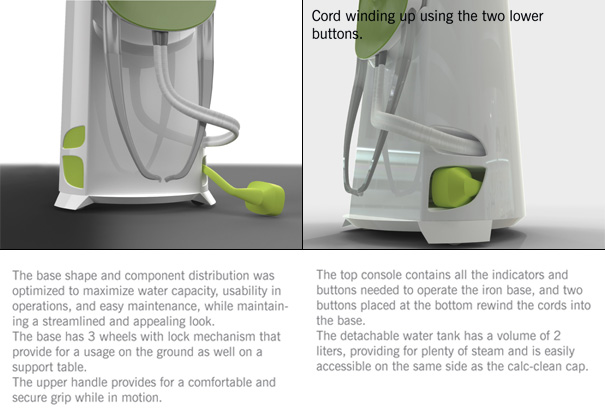
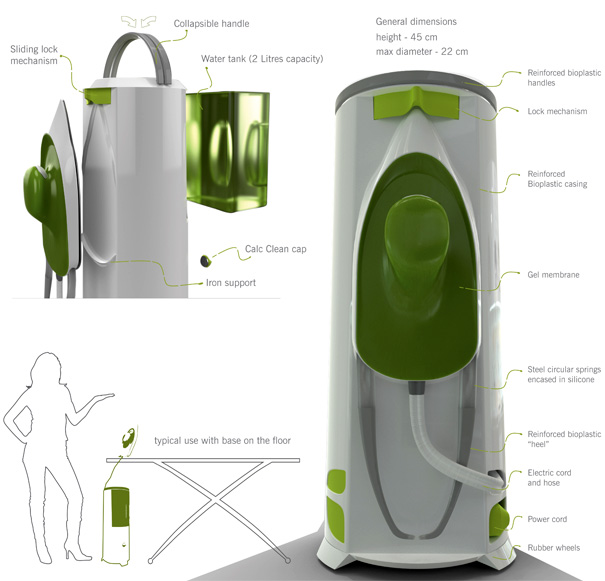
The base shape and component distribution was optimized to maximize water capacity, usability in operations, and easy maintenance, while maintaining a streamlined and appealing look. The base has 3 wheels with lock mechanism that provide for a usage on the ground as well on a support table. The upper handle provides for a comfortable and secure grip while in motion. The top console contains all the indicators and buttons needed to operate the iron base, and two buttons placed at the bottom rewind the cords into the base.

The detachable water tank has a volume of 2 liters, providing for plenty of steam and is easy accessible on the same side as the calc-clean cap. When not in use the iron/base have a reduced footprint of 20×20 cm and a height of 45cm, occupying very little at the users home and reducing transportation operating costs for the manufacturer.

Designer: David Gonçalves for Studio NAMIC

Let’s Play Lego Sockets

Rotating 360° is a multi-outlet socket system that allows you to add many sockets to the strip – ala Lego style. The main feature is that you can turn around the socket-outlets in any direction, so as to accommodate various plugs. You have to admit that this is a cool idea.

Designers: Cheng-Hsiu Du & Chyun-Chau Lin

Come Share My Music

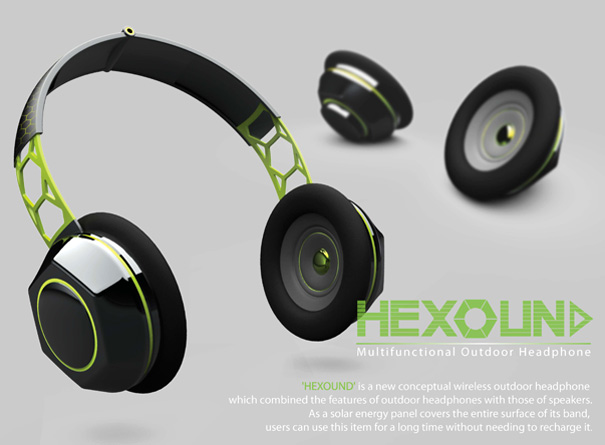
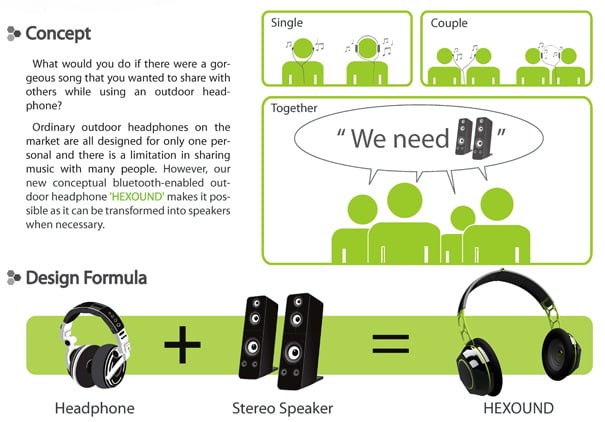
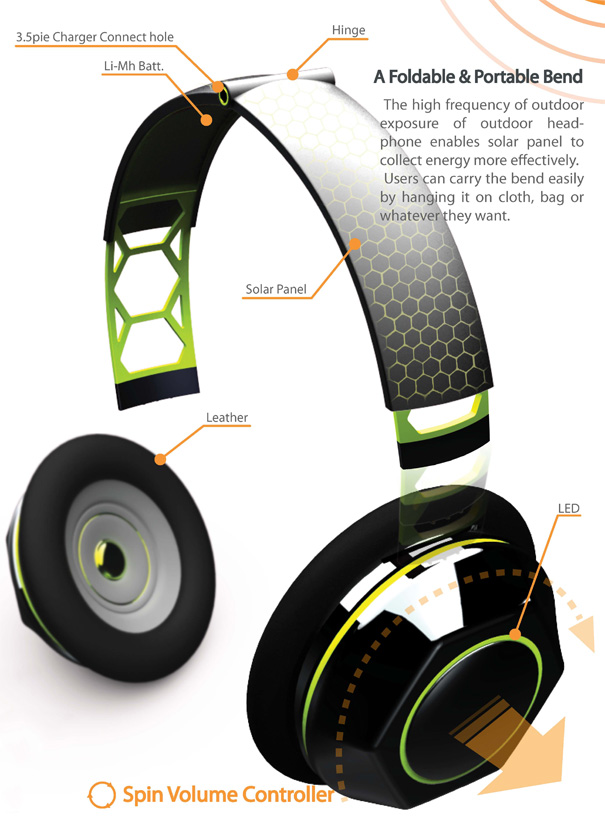
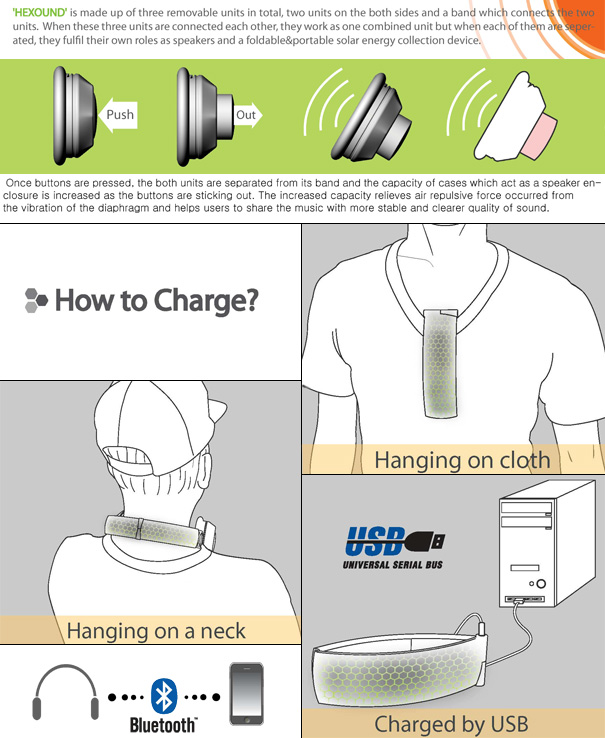
The very special Hexound is a headset that detaches to become portable speakers. The cool-quotient is brought in by the solar panel fixed in the headband. Specs include Bluetooth connectivity and intuitive controls. I simply love the versatility of becoming a crowd-friendly device from a personal thang.

Designer: Lie Zhong-Fa

Three Dimensions for the Fourth

Lemme tell you before we start, this is one of those concepts that, although it ends up being rather simple, starts really deep. This is a clock whose roots go all the way back to the history of humanity, the realization of time, and the portrayal of it in written or sculpted form. The designers of this clock recall ancient Egyptian Priests, Celtic Druids, Roman Engineers, and Renaissance Artists, each of them attempting to specify time with a single boundary. This breaks that.

To break out of the notion that all time is a boundary, and that although time is but a moment, it’s always moving in more than one dimension, the designers of this clock, “Monolith,” have taken time to two sides. This clock is a block, and on two sides of it the time is displayed.

This is an art work that can be made in any color. It’s got an LEG display, polished surfaces (glass or plastic,) alarm function, and works with batteries. To be placed on coffee tables, commodes, and office furniture.

This design is a 2010 Red Dot Design Award winner!

Designer: Negrocobre Design Studio


Revenge of the Piggy Bank

The tradicional porcelain piggy bank has always been broken by its owner. Now armed and ready it wants revenge! Unfortunately for the pig, the brass hammer just makes it easier for you to smash it apart. Cute.


Designer: Furf Design Studio

An interview with Collin Antos, part 2: Bringing an old sewing machine back to life

0collinantos21.jpg

If my Part 1 talk with Collin Antos sounds like a commercial for the Singer 15-91, that's because originally that was the goal: When I first came across Antos and read about his extensive refurbishment process for these sewing machines, I thought "Man, we gotta ask him to sell these through Hand-Eye Supply!"

0collinantos24.jpg

I figured our readers who'd want a machine like this would want to avoid the frustrating eBay bidding process, where victory is often snatched away at the last minute. It's even more painful losing a bid on an Antos machine, as I have, because they're so individual--he does extensive write-ups on the specific process for each machine, gives the machine's serial number (which you can then look up on Singer's website to see where and when it was made), and even shoots an individual YouTube video showing the specific machine sewing through a variety of materials. You can see the one he made for the machine I eventually bought from him down at the bottom of this entry, and my machine itself is pictured here going under the knife.

0collinantos22.jpg

(Despite our wooing efforts, Antos is skittish about turning a hobby into a business. Unless we can get the guy to change his mind, if you want to buy one of his machines you'll have to go through the bidding process on his eBay wares.)

Now for Part 2 of our interview, where Antos gives us the breakdown on breaking these machines down, then building them back up. It's a heckuva lot more involved than cleaning out half-a-century-old gunk and replacing World-War-II-era wiring.

0collinantos23.jpg

The guy makes his own springs, for chrissakes.

Core77: Please tell us about your repair process.
Collin Antos: My repair process is very intense. I remove 163 pieces from the machine and clean each one with rubbing alcohol, and on metal functional pieces (like the thread tensioning plates) I use 00 grade steel wool.

There are two springs in the bobbin winding assembly that, if broken, no replacements exist for. So I actually bought 12-inch spring stock of the same wire diameters and opening diameters and I form replacement springs myself.

I remove and resolder in, new, all of the wires from the motor, the foot controller and the light. Then I crimp and solder on electrical O-Ring-style wire terminators so that if something goes wrong on the machine in the future it can be serviced easily...

...I disassemble the light and rebuild and scour the switch--that means I actually disassemble the switch itself and remove every part it--so the entire thing is like brand new.

I take the foot controller apart and clean all of the contacts. If the controller has springs for a rheostat then I replace those as well.

I completely take apart the bobbin section and steel wool and alcohol every piece.

The thread tensioner gets completely disassembled and scrubbed with steel wool and alcohol and then reassembled. Even though this is an easy part to disassemble and clean it's the hardest part to reassemble correctly.

The light is actually the most difficult part, its very time-consuming and probably takes me 1.5 hours alone.

I should also mention that I even steel wool and alcohol clean every screw that I remove.

The direction lever and the plates behind it get removed. Then I put Singer-brand machine lube around the outside edge of the inner direction plate so when you set your reverse up, it slides super-smooth.

On the face of the machine I remove the cover plate and clean all of the moving parts. Cleaning the tensioner, the bobbin case, and under the front cover plate are very important because if there is any oil or dirt or grime in these areas it will discolor the thread as you sew.

I readjust the bobbin winder and put on a new rubber bobbin tire.

On the back of the machine I take the handwheel off and remove the motor completely. Then I clean out each tooth on the gears individually to remove the old congealed grease. I clean out the gear chamber and the lube tubes. This is a foul job because the old grease is just gross and messy. I put new Singer brand machine lube and reassemble the handwheel and motor. Then I oil the machine using Singer brand oil.

The instruction manual shows every spot that needs oiling so anyone can do it themselves, which is very convenient. Also the oil and the lube can be found at any chain fabric store and cost about $3 each and would be a lifetime supply for 1 machine.

The last thing that I do is use turtle wax on the black surfaces. This gives a great shine....but the secret is after the turtle wax has been removed (just like you do on your car) put about 5 drops of the Singer oil right on the bed and then 5 more drops right on the top of the machine. Then use an old soft knit cloth and rub the oil into every black surface. If you want a show-room-shine that's the way to get it! Don't be afraid to do it because 99% of the oil comes off on the cloth and the results are amazing.

* * *

Below is the original video Antos sent me in advance of me buying this machine. It is long and practically unedited, as Antos wants to assure the buyer he is not intercutting footage of a different machine, but scanning through it should give you the idea.

So, the big question is, how can you buy one of his machines? He operates at eBay under the screenname "mossheart." At press time he had no machines available so there's nothing to link to.

Want to beg him, as we did, to sell these on Hand-Eye Supply? Leave a note for him in the comments!

Core77

Defying product obsolescence: What you can do with a 60-year-old machine. An interview with Collin Antos, part 1

0collinantos1.jpg

Aside from a few power tools, I don't own anything with moving parts that's more than five years old. Stuff breaks and becomes obsolete. So the thought of buying a sturdy machine that was built sixty years ago and will easily serve me through the next twenty, is cheaper than a brand-new machine that does the same thing, and requires virtually no maintenance, has a powerful allure. Which is why I bought an old Singer sewing machine from Collin Antos.

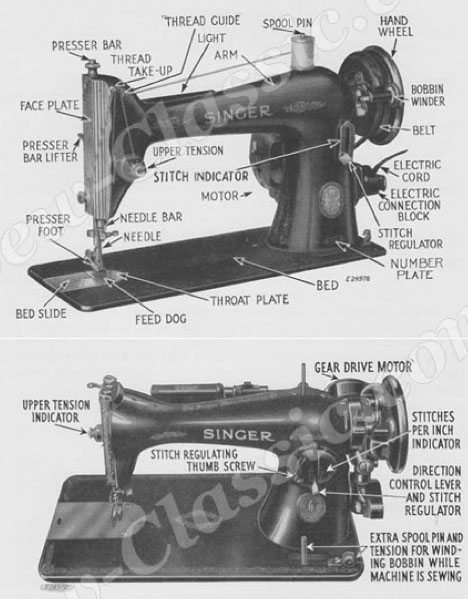
Antos, a 31-year-old engineer, uses the Singer 15-91 model in his spare time to make everything from curtains to carry-on luggage to messenger bags. He is an unabashed Singer 15-91 geek and lovingly restores them in his spare time.

Core77 recently interviewed Antos on what makes these machines special and different in a crowded marketplace, why they have survived obsolescence and may even be superior to modern machines, what you can make with them, and how he fixes them up. In analyzing his answers, we see this conversation is actually about a lot more than a simple sewing machine, and in fact helps illuminate the way we think about products we own and what we really want from them. His answers are long, in a good way, so it'll be presented in two parts. We think you'll find it interesting.

Core77: Can you tell us about your dual engineering/industrial design educational background?
Collin Antos: When I was in high school I really wanted to design and make shoes. I started off just studying Bio-Mechanical Engineering at Syracuse University, but I realized that I was missing two other parts that encompassed manufacturing, and those were Textile Science and Industrial Design. I took as many classes as I could in both and met some amazing people who taught me so much about how different views come together during production.

Since graduating I have always worked in a manufacturing plant as an engineer. Having an industrial design background has been such an advantage for me professionally, because normally engineers and artists are standing on opposite sides of the room. Having an understanding of the artist's point of view as well as the manufacturing product lifecycle, including machine limitations, has made working together so much easier.

How did you get into sewing and repairing sewing machines?
I learned to sew in a 7th grade Home Economics class. I love to build things, very different things, it doesn't matter what it is. For example I love woodworking and have slowly been building up a nice little shop in the garage. Sewing has always sort of been simmering in the background and usually bubbles to the surface for me when I see something in a catalogue that I like.

One of the most important things for me is owning only Made in America items. Sadly it's EXTREMELY hard to do. Yes, I own a cell phone, Macbook and iPod and none are made here (although the software was) and they were all designed here. This is why sewing comes to the surface so often; if I can't find it Made in the USA I try to make it myself....

... Sometimes it takes me a few tries and a lot of times the end result looks homemade, but for me, as long as I can say that I stay true to my beliefs then I am happy with a homemade-looking hat.

For a long time I was using my grandmothers Kenmore sewing machine from the '70s and it was not made to be used to do projects of the 'see if it's possible' variety. Lately I have been really into sewing duffelbags and messenger bags out of duck cloth, and the thick materials just were too much for it.

I started doing research on the internet about used (can't buy a new one because it wouldn't be Made in the USA) sewing machines and I came across a cult following for the 15-91. Singer made loads of different model machines in the USA and I settled on the 15-91 based on what I had read. As it turned out the only ones I was willing to afford did not run, so when it first arrived, I cleaned it and rewired and got it running and actually had done my first refurbishment without even knowing if the thing was worth it or not.

When I finally finished and plugged it in, not only did it turn right on but it had a perfect stitch. I tried it on a dufflebag that I had set aside out of frustration with the Kenmore--and it blew me away. For me the 15-91 opened up a whole new world of possibilities. There was no longer a machine-imposed limit to my projects. For years I had been struggling, and then just-like-that everything just worked. Have you ever wanted to do something and then just by chance you find a tool that lets you do exactly what you needed? For me that's what the 15-91 did. In my opinion it's the greatest model of sewing machine ever made and that's really how I got into refurbishing them. Once I said: 'Everyone who sews needs one of these.' I knew that not only does everyone need one, but everyone will want one!

What kinds of things are you capable of sewing? Can you give us an idea of some of the practical things people can make using the Singer 15-91?
The great thing about the 15-91 is that it sews everything, and I mean everything. I have sewn one layer of sheer rayon to make curtains and I've sewn eight layers of duck cloth making carry-on luggage.

The thing that sets this machine apart is the power and versatility that it has. Not just the power to sew through thick canvas but also the versatility to switch to making boxer shorts.

I am an amateur when it comes to sewing and some of the common issues that were obstacles for me, like irregular stitch length, were eliminated because of the design of this machine. Anyone who has tried to casually sew on a modern home machine knows that if you aren't an expert you tend to get variations in your stitch length. This is because an inexperienced user will push or pull the material as it is worked through the machine. The 15-91 has so much strength between the feed dogs and the presser foot that it won't let you force the material through, it just takes it as it wants it. This has actually helped make me a much better seamster, because its like having a constant instructor reminding me to relax and let the machine pull it at its own pace.

My stitches also come out straighter because, on other machines as you force the fabric through it tends to walk or slide to one side or the other making, your straight-line stitch look like a wave that wanders back and forth as you try to bring it back into line.

Even though this is a powerful machine and is probably more capable than any home hobbyist really needs, because of its reasonable pricing even on fully refurbished machines I would recommend it to anyone who is thinking of buying even their first sewing machine. The 15-91 is the kind of machine that corrects the beginner and encourages the expert.


Do you repair a range of sewing machines? If so, can you tell us some of the different characteristics?
I do not repair any other sewing machines other than the 15-91. It sounds strange but since it's a hobby and I feel so strongly about the capabilities of this one particular model, that I would feel like I was doing people a disservice, if I refurbished anything other than the model I would use myself.

Tell us about the Singer 15-91's specific design.
My favorite thing about the 15-91 is the gearing. Every year I would take my Kenmore in for its annual 'tune up.' This would readjust the timing and oil it up and check the belts etc. Even though I spend about 10-15 hours cleaning, rewiring and modernizing the 15-91 I have NEVER had to adjust the timing of any of the gears. It's amazing.

I've gotten machines that have been flat-out abused. Ones that I've put my hand on my head and thought 'no way will it run' and sure enough no matter the condition, no matter the past treatment they put out the most beautiful stitch you could ever ask for. That also means if you buy a refurbished machine you will only need to oil it and it will keep running as perfectly in 20 years as it does the day you buy it.

Also this machine has a direct drive set up, which means there are no belts in this machine at all. It uses just gears to gears. This provides the power. While a belt can slip the gears can not.

Why are you attracted to this particular machine?
There are so many things that make this machine my perfect choice. The oil, light bulb, bobbin tire and bobbins (which are all a normal user would ever need to replace) are commonly available in chain stores. Its easy to understand and easy to learn. The 15-91 has all of the muscle you could ever need, yet can switch to sewing silk without a hiccup. It compensates for my bad habit of forcing the fabric through and gives me a great stitch every time. Plus they are super easy to fix. The timing never needs adjusting. All of that means I can just sit down and sew without having to worry about anything.

What's the hardest thing you've ever made with a sewing machine? And the easiest?
The hardest thing I've ever made are by far boxer shorts. They are a pain in the butt. The easiest thing I've ever made is a winter hat and scarf. If you are looking for a fun project to get familiar with sewing, try a hat and scarf made out of fleece. The ends won't fray and the material cuts really nicely. Plus everyone needs a winter hat.

Is a Singer 15-91 a good machine for beginners? Also, what does it have to offer to people with a lot of sewing experience?
Absolutely. The price of a fully refurbished 15-91 is comparable to an entry level modern machine, but you get so much more quality. The 15-91 has so many things that should attract beginner level sewers as well as experienced ones:

1. The versatility to sew on any material and any thickness.

2. The price is comparable to beginner level modern machines

3. It compensates for your inexperience by overpowering your tendency to force the material through, creating irregular and wandering stitches.

4. The machine only goes in forward and reverse and makes a variable length straight stitch. You will become comfortable using this machine after only a few hours. This will make you feel more at ease and more willing to come back to it to try more projects.

5. Dependability. If you know you can't hurt it, you will take more chances and have more fun.

6. You are more likely to become an expert if you have a machine that you want to sew on, and if you have been able to try a wide variety of projects without wondering if the machine can do it or worrying about complicated settings.

7. An expert seamstress will love this machine because it has a natural feel. If you already know how to sew and you have made many things before, you will want a machine that is easy to learn, has the power to do what you ask it when you ask it, and feels like an extension of your body.

Core77